Insuring a Wine Collection: What Homeowners Policies Usually Miss
Thinking of insuring a wine collection? Most homeowners policies aren’t built for this, but professional storage is here to help.

You pull a bottle you’ve been saving for years, a wine you know well from a producer you trust, in a vintage that should have been special. You pour it, and something’s off. The complexity you expected isn’t there and it tastes more evolved than it should. You shrug and chalk it up to bottle variation.
It might not have been the bottle, but rather, it might have been where you kept it.
Can vibration damage wine? The short answer is yes — and it’s one of the most overlooked reasons why wine stored at home doesn’t always deliver on its potential. Unlike a pushed cork or a heat-damaged bottle with obvious signs of leakage, vibration damage leaves no calling card. It just quietly accelerates a wine’s aging, robbing it of the nuance and complexity that would have developed on its own terms, in its own time.
Here’s what we know, and what you can do about it.

Think of wine as a slow-moving chemistry experiment happening inside a sealed bottle. Over months and years, acids react with alcohols to form esters (some of those beautiful floral and fruity aromas), tannins gradually polymerize and fall out of solution as sediment, and delicate aromatic compounds exist in a kind of careful equilibrium. All of this happens slowly and, ideally, undisturbed.
Vibration throws a wrench into that process in a few ways.
The most studied effect is what it does to sediment. In older red wines, sediment is completely natural, it’s just tannins doing what tannins do over time, slowly precipitating out of solution. Regular vibration keeps that sediment stirred up and suspended, which means those tannins remain chemically active rather than settling out. The aging process you’ve been waiting for gets interrupted.
Beyond sediment, research published in the journal Food Chemistry found that vibration accelerates the oxidative chemical reactions happening inside a bottle. The wine essentially ages faster, but not better. What the researchers found was a kind of forced, ungraceful evolution. Nuance compressed. Aromatics flattened. The bottle rushed toward a destination it should have reached gradually over years.
A more direct study, published in the Journal of Food Quality, tracked a commercial red wine stored under four different vibration intensities over 18 months. The results were clear: the higher the vibration level, the more accelerated the changes to the wine’s organic acids, tannins, and refractive index. The researchers concluded that vibration can substantially speed up wine evolution, and that wines stored at higher vibration levels showed the most significant deterioration. Their conclusion was direct: to produce high-quality aged wines, vibration should be avoided.
Here’s the thing about vibration: it’s everywhere in a typical home, and it’s almost impossible to eliminate without purpose-built storage. Let’s walk through the most common situations.
Kitchen wine racks are the worst offenders, even though they’re incredibly popular. Refrigerators have compressors that cycle on and off all day. Dishwashers run cycles. HVAC systems hum in the walls. Then there’s the general activity of a kitchen like cabinet doors, foot traffic, someone setting a heavy pot down on the counter… None of it is dramatic in isolation, but for a bottle sitting there for five or ten years, it adds up.
Under-stair storage gets chosen a lot because it feels naturally cool and tucked away, but stairs are essentially a vibration transmission system. Every time someone walks up or down, that energy travels through the structure of the house and right into the bottles.
Home basement cellars are the best home option by a wide margin, but in a city like New York, “basement” often means you’re near a mechanical room, an elevator shaft, building HVAC equipment, or street-level traffic. A cellar in a Manhattan apartment building can actually be subject to more ambient vibration than a kitchen in a quiet suburban house.
Wine refrigerators deserve a special mention here because many collectors assume they’re solving the problem. Temperature-wise, they are. But most freestanding wine fridges use compressor units that transmit vibration directly through the rack to every bottle inside. Thermoelectric coolers eliminate the compressor vibration problem, but they struggle with temperature consistency in variable ambient conditions. Neither is really ideal for long-term aging.
It’s worth being honest about scale here. If you’re buying wine to drink within the next few months, vibration is not your concern. A bottle on a kitchen rack for a few weeks before dinner on Saturday is completely fine.
The math changes when you’re talking about wines meant for the long haul. A case of 2023 Burgundy futures you’re not going to touch until 2030. A horizontal of Barolo that needs another decade. Champagne you’re accumulating for milestone occasions. These are wines where the total storage conditions over their entire aging period determine what ends up in your glass. And for those wines, vibration is a real, cumulative factor.
The effects of lower-level ambient vibration accumulated over many years are harder to isolate in controlled studies. But experienced sommeliers and collectors who have tasted the same wine stored under different conditions side by side will tell you: the difference is real, and it can be striking.
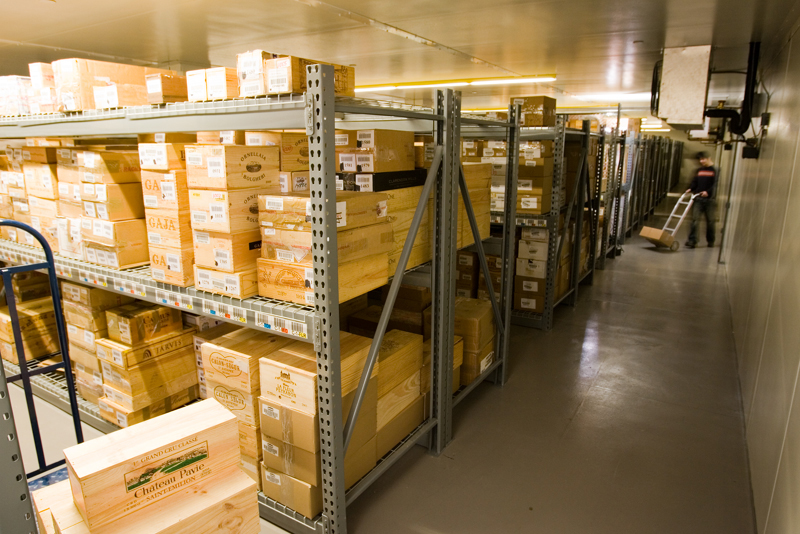
Eliminating vibration isn’t something you can DIY with foam padding under a rack or by moving bottles to a quieter corner. It requires a facility designed from the ground up to minimize vibration transmission through the building structure, through mechanical systems, and through the storage racks themselves.
At The Wine Cellarage, vibration protection is a core feature of both our 22,000-square-foot Bronx facility and our 8,000-square-foot Stratford, Connecticut location. It sits alongside temperature maintained at a consistent 55°F, controlled humidity, and full light protection as one of the four non-negotiables of how we store wine. It’s not a bonus feature — it’s fundamental. The whole point of professional storage is that your wine ages under conditions a private home simply can’t replicate.
If your collection has resale value, storage conditions affect more than just what the wine tastes like. Fine wine sold at auction is assessed in part on provenance: where it was stored, under what conditions, and with what documentation. Wine with a verifiable professional storage history commands more confidence than wine that’s been at home in an unknown environment.
Vibration damage in wine is especially tricky in this context because it leaves no external trace. There’s no obvious flaw to see before opening. It only shows up in the glass and by then, the opportunity to protect that value is long gone.
Our collection management platform integrates live market pricing and Christie’s resale functionality because we understand that our clients’ collections aren’t just bottles to drink, they’re assets worth protecting. Proper storage, including vibration-free conditions, is part of how we protect them.
Not sure whether your setup is exposing your wine to problematic vibration? Here are a few things to think about:
Is your storage near any of the following? A fridge or freezer compressor, a washing machine or dryer, an HVAC system or boiler, an elevator shaft, a heavily used staircase, a garage, or street-level traffic. If so, vibration is worth taking seriously.
Do bottles you haven’t moved show sediment that won’t settle? If bottles you haven’t touched in months consistently look cloudy or show suspended sediment rather than a clean settled layer at the bottom, ambient vibration could be contributing.
Have mature wines from your home storage tasted more evolved than expected? Lots of factors affect wine development, but accelerated aging that produces flat or simplified flavors, especially in wines you know are capable of more, can point to storage conditions.
A great wine collection is built over years of careful buying and patient waiting. The storage decisions you make in between determine whether those wines actually deliver when the moment finally comes.
If you’re questioning whether your current setup is up to the task, we’re happy to talk it through. We work with collectors of all sizes, from a few dozen bottles to cellars spanning thousands. Our team serves the greater New York metro area from the Bronx, and Fairfield County, New Haven County, Westchester County, and surrounding areas from Stratford, CT with door-to-door pickup and delivery via our fleet of temperature-controlled vans.
For commercial clients with imported inventory, our Connecticut facility also operates as a bonded warehouse, offering duty deferral advantages on top of professional storage conditions. The wine in your cellar deserves to become what it was made to be. Don’t let vibration be the thing standing in the way. Learn More at www.winecellarage.com
Thinking of insuring a wine collection? Most homeowners policies aren’t built for this, but professional storage is here to help.

Temperature gets all the attention in wine storage, but wine humidity is just as critical. Here’s what goes wrong when it’s not controlled.

When your futures allocation finally arrives, where it goes first matters. Professional storage should be step one of storing wine futures.