Insuring a Wine Collection: What Homeowners Policies Usually Miss
Thinking of insuring a wine collection? Most homeowners policies aren’t built for this, but professional storage is here to help.

Most people treat Champagne as the wine you open immediately. It arrives chilled, it gets uncorked at the right moment, and that’s that.
But spend time with serious wine collectors, and you’ll find that aged Champagne occupies a particular place of reverence. A fully matured vintage Blanc de Blancs at fifteen years is just one of the most complex, layered drinking experiences wine has to offer — and storing it to get to that point requires patient, careful, storage.
Champagne undergoes two fermentations. The second fermentation, which happens in the bottle and creates the bubbles, leaves behind dead yeast cells that remain in contact with the wine for months or years. This breakdown of yeast cells contributes the brioche, toast, and biscuit complexity that distinguishes fine Champagne from cheap sparkling wine.
After this process, aging continues in the bottle. The small amount of oxygen present interacts with the wine’s compounds over time, developing the honeyed, nutty, savory, and oxidative notes that characterize mature Champagne. Acidity, which Champagne has in abundance, serves as a structural backbone that supports this long development.
But there are physical realities that make Champagne storage more demanding than still wine storage.
The pressure inside a Champagne bottle runs at approximately 90 psi. This is roughly three times the pressure in a car tire. This pressure interacts with the closure in ways that still wine doesn’t have to contend with. The cork in a Champagne bottle is mushroom-shaped and wired down specifically because the internal pressure would push a standard cork out. Over long storage, that pressure works constantly against the seal.
Champagne corks are composite, not natural. The bottom portion that contacts the wine is typically a disc of agglomerated cork, which behaves somewhat differently from the natural cork in a still wine bottle. It’s designed to withstand pressure but is also more sensitive to temperature extremes and dryness.
The effervescence itself is a finite resource. CO₂ slowly migrates through any closure over time. Improper storage accelerates this process. A Champagne that’s stored too warm or with inadequate humidity doesn’t just lose flavor, it loses its defining physical characteristic.
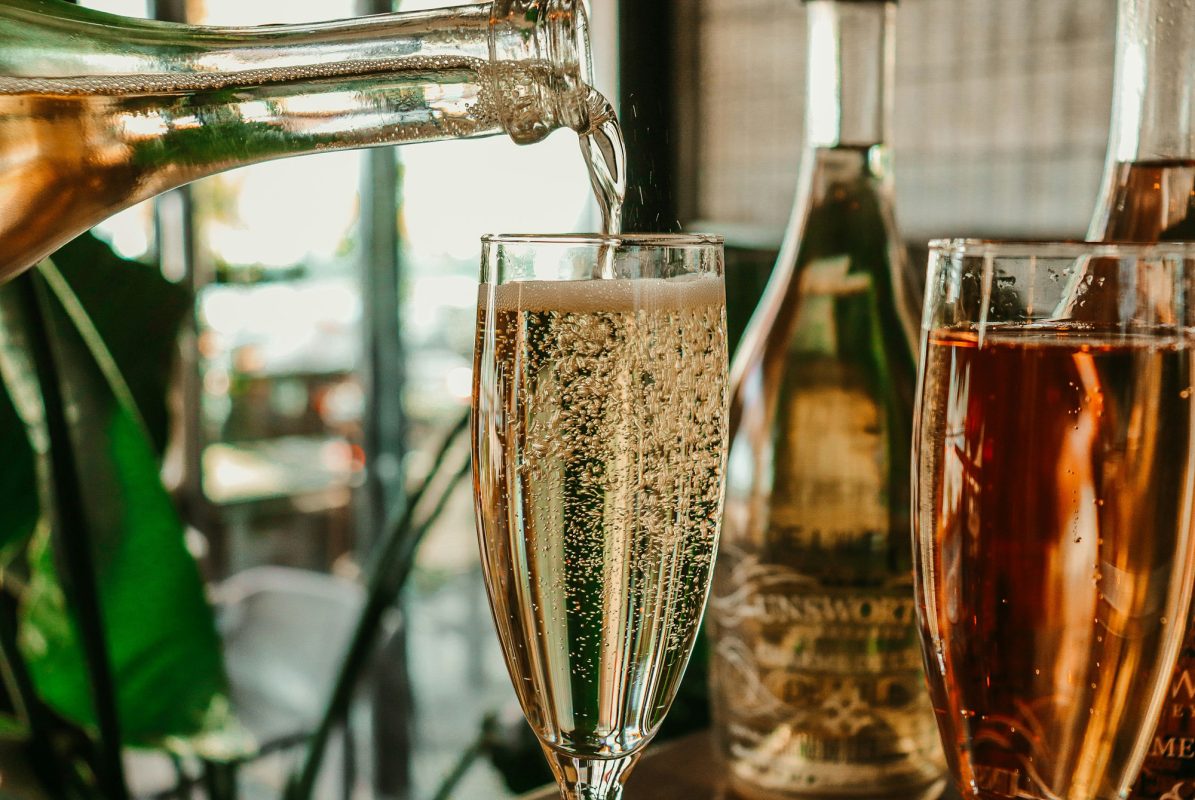
For still wine, the target is a consistent 55°F. For Champagne, the same target applies, but the margin for error is smaller.
Heat accelerates CO₂ loss. A Champagne stored at 65°F will lose its effervescence significantly faster than one stored at 55°F. The chemical reactions that govern flavor development also accelerate with warmth, and Champagne’s flavor profile is more delicate and more easily disrupted than most red wines. The citrus, mineral, and floral notes that make young Champagne vivid can become muted and oxidized quickly when exposed to inconsistent temperature.
When it comes to humidity, Champagne corks present a particular challenge. Because it’s designed to resist pressure from inside the bottle, the cork fits tightly. This is the right engineering choice for what the cork needs to do, but it also means the cork is more sensitive to drying out.
A dry environment causes the cork to shrink. In a still wine bottle stored horizontally, this can introduce oxygen. In a Champagne bottle, it can also compromise the pressure seal — allowing CO₂ to escape and oxygen to enter simultaneously.
The target humidity range for Champagne storage is the same as for still wine: 60–70% relative humidity. But the consequences of falling below that range are more immediate. At 50% or lower, Champagne corks can begin to fail within months. A collection that looks perfectly intact from the outside may be silently losing pressure.
This is one of the reasons home storage of Champagne is particularly risky. Most home environments run well below 60% relative humidity, especially in heated spaces during winter. A wine fridge that doesn’t actively humidify makes the problem worse, not better.
Now let’s consider light.
Champagne is among the most light-sensitive wines produced. The phenolic compounds responsible for its aromatics are highly susceptible to UV degradation.
Light strike produces a sulfurous, rubbery, or wet cardboard character that’s immediately unpleasant and completely masks the wine’s actual qualities. The reaction is fast: a few hours of direct sunlight can damage a bottle. Even diffuse indoor light over extended periods causes measurable harm.
Most Champagne is bottled in dark glass for exactly this reason. But dark glass is not complete protection, it significantly reduces but doesn’t eliminate UV transmission. Long-term aging requires actual darkness, not just filtered light.
The practical implication is that Champagne should never be stored in glass-doored wine fridges, near windows, or under fluorescent lighting. Professional storage facilities maintain true darkness, eliminating light strike as a variable entirely.
The bottom line: Champagne requires the same standard as fine still wine — constant 55°F, no seasonal variation, no daily compressor cycling, monitored humidity — and it’s less forgiving when that standard isn’t met.
For short-term storage (up to a year or two), upright storage is fine as the internal pressure prevents the cork from drying out. For long-term aging, traditional horizontal storage is still generally preferred by serious collectors and facilities, as it keeps the wine in contact with the cork and provides the same insurance against drying that it provides for still wines.
The more important point is that the position should be consistent. Moving bottles frequently disturbs the wine, stresses the cork, and disrupts the slow settling that characterizes long-term aging. Once a Champagne destined for long-term cellaring is in position, it should stay there.
Not all Champagne benefits from extended cellaring. Non-vintage (NV) Champagne is blended for consistency and immediate enjoyment. The house style you know and love is calibrated for current drinking. Holding it for five or ten years won’t improve it, but rather diminish it.
Consider storing Champagnes worth aging:
Vintage Champagne is produced only in exceptional years, when the harvest is good enough to merit a single-year bottling rather than a multi-year blend. These wines have the structure and complexity to develop over time. Most are released with 5–7 years of age already, and the best can continue developing for another 10–20 years depending on the producer and vintage.
Prestige cuvées — Krug Grande Cuvée, Dom Pérignon, Louis Roederer Cristal, Salon, and their peers — are typically the most complex and age-worthy wines in their producers’ ranges. They’re made with the finest fruit, often from single vineyards, and receive extended lees aging before release. These are the bottles that reward decades of cellaring.
Blanc de Blancs from great terroir — particularly those from the Côte des Blancs, especially Cramant, Avize, and Le Mesnil-sur-Oger. These tend to have the mineral intensity and high acidity to age exceptionally well. A Champagne from Pierre Peters, Agrapart, or Larmandier-Bernier can evolve beautifully for 15–25 years in ideal conditions.
Blanc de Noirs from serious producers made primarily or entirely from Pinot Noir — can develop extraordinary depth and vinosity with age. These are less commonly cellared than Blanc de Blancs but increasingly sought by collectors.
Thinking of insuring a wine collection? Most homeowners policies aren’t built for this, but professional storage is here to help.

Temperature gets all the attention in wine storage, but wine humidity is just as critical. Here’s what goes wrong when it’s not controlled.

When your futures allocation finally arrives, where it goes first matters. Professional storage should be step one of storing wine futures.