
Insuring a Wine Collection: What Homeowners Policies Usually Miss
Thinking of insuring a wine collection? Most homeowners policies aren’t built for this, but professional storage is here to help.

There comes a moment most serious wine collectors hit eventually. You’ve just bought a case you’re excited about, you go to find space for it, and you realize — there isn’t any.
If you’ve been here before, you’ve outgrown your setup and it’s time to either buy another wine fridge or consider professional storage. Before you place an order for another fridge that you don’t have the space for, it’s worth understanding what professional actually entails.
The instinct to buy more home storage equipment makes sense. It’s immediate, it feels like control, and it seems cheaper than a storage program. But a second wine fridge brings the same limitations as the first, it just takes longer to fill.
Home wine fridges are just appliances designed for accessibility, not for serious long-term aging. They cycle on and off to maintain temperature, which creates micro-vibrations that accumulate over years of aging. Their humidity control is limited or nonexistent, which can dry out corks over time. They’re not monitored when the power goes out. And if something goes wrong — a compressor fails, a door seal weakens, a power outage hits — you may not know until the damage is already done.
For a collection of 50 or 100 bottles you’re cycling through regularly, that tradeoff is reasonable. For wines you’re holding for 10, 15, or 20 years? The risk profile changes significantly.
You’re buying more than you’re drinking. If your collection is growing rather than turning over, the wines you’re adding are meant to be held — and held wine needs proper conditions, not just convenient conditions.
You have bottles you care about. There’s a difference between storing a case of weeknight wine and storing a mixed case of 2019 Burgundy you’re holding until 2035. The stakes are different and the storage should be too.
You’ve started making compromises. Buying less than you want, drinking wines before their window, or stacking cases somewhere they don’t belong. The garage, closet, basement with fluctuating temps… These are all signs the storage is now dictating the collection rather than the other way around.
You’re thinking about resale. If there’s any chance you’ll sell bottles later through auction or private sale, provenance documentation starts with where the wine is stored. A professional facility creates that record automatically. A home fridge doesn’t.
You’ve experienced a close call. A brief power outage, a fridge that ran warmer than you realized for a few weeks, a summer where the basement got hotter than expected… One incident is a warning, waiting for the second one is
The phrase “professional wine storage” can sound vague, so it’s worth being specific about what it means in practice.
At a proper facility, temperature is held at a constant 55°F — not cycling toward it, but maintained at it, 24 hours a day, 365 days a year. Humidity is regulated in the range ideal for long-term preservation, protecting corks from drying out without creating mold conditions. There’s no light exposure. Vibration is controlled. And the facility is monitored digitally around the clock, so any deviation triggers a response — not a discovery weeks later.
The wine is also insured while it’s there, which is a detail most collectors don’t think about until they need it. Standard homeowner or renter policies typically either exclude wine entirely or cap it at amounts well below the value of a serious collection.
Beyond the physical conditions, a good storage program gives you visibility into your collection in a way a home setup doesn’t. The Wine Cellarage’s storage program, for example, includes a collection management platform where you can track real-time market values, monitor drinking windows, and request delivery on demand. For NY and CT collectors, that means hand-delivery to your door in a temperature-controlled vehicle — your bottles don’t get warm in transit.
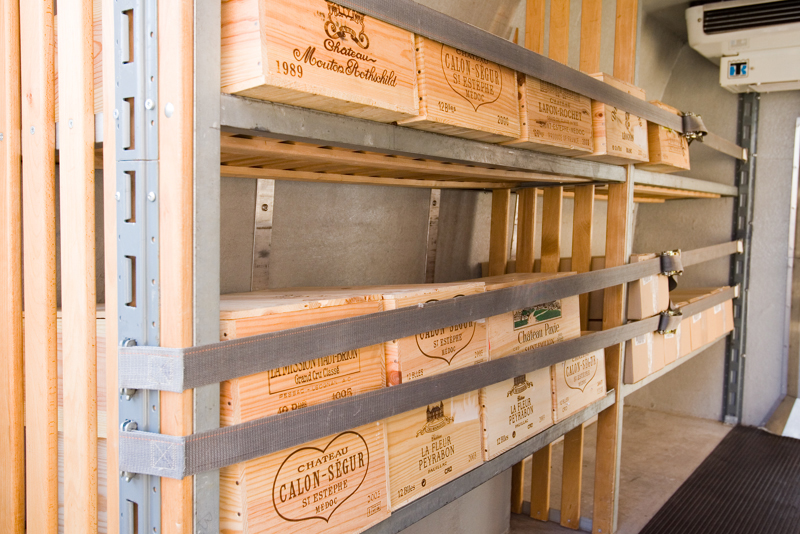
The practical question most collectors have is: how complicated is it to move wine from home to a storage facility?
The honest answer is that it’s simpler than it sounds, especially when the facility handles pickup. Our team at The Wine Cellarage operates a fleet of refrigerated Mercedes Sprinter vans maintained at 55°F, and they handle local pickups door to door throughout New York and Connecticut. You don’t need to box everything up and drop it off somewhere.
Before the pickup, it’s worth doing a quick inventory to know what you have, roughly what you paid, and what you’re holding vs. planning to drink soon. That catalog becomes the foundation of your storage record, and it’s what makes the collection management platform useful from day one.
Once the wine is in, you can request bottles back at any time. The storage program isn’t a vault you hand wine off to and forget, it’s a managed environment where your collection stays accessible while being properly cared for.
You don’t necessarily need to move everything. A practical approach for most collectors is to keep a small rotating selection at home and move anything you’re holding longer term to the facility.
Think of it as a working cellar at home and a proper cellar with us. The bottles you need tonight are within reach and the wines you’re aging for a decade are somewhere they’ll actually benefit from the time.
If you’re based in New York or Connecticut, contact the storage team to talk through your collection and get a custom quote. Pickup can be scheduled at your convenience.
Thinking of insuring a wine collection? Most homeowners policies aren’t built for this, but professional storage is here to help.

Temperature gets all the attention in wine storage, but wine humidity is just as critical. Here’s what goes wrong when it’s not controlled.

When your futures allocation finally arrives, where it goes first matters. Professional storage should be step one of storing wine futures.